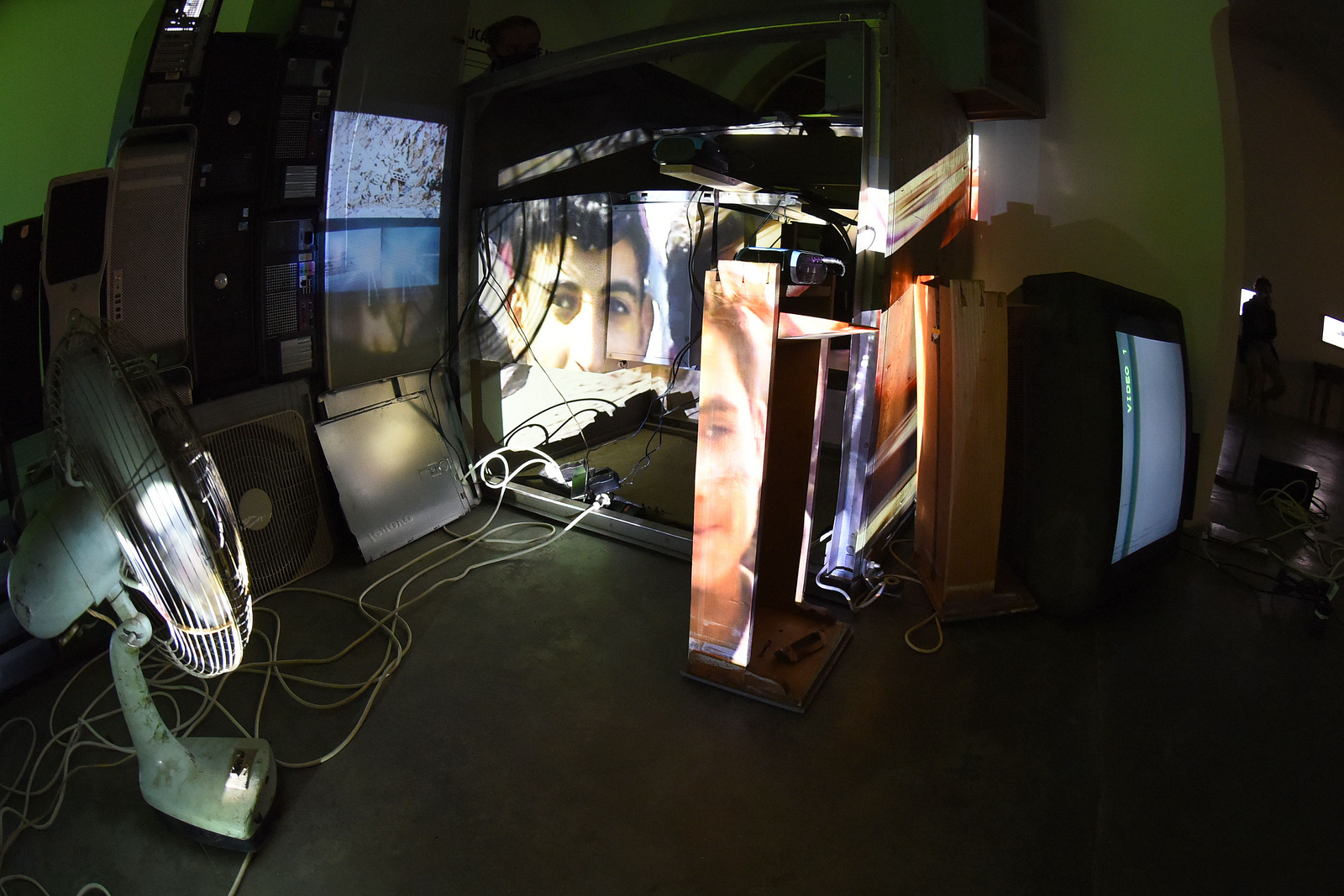
Entry to Brooke Alexander Gallery, New York, NY (1984) by Joseph Nechvatal

Cybernetics, Systems Theory, Environmental Art, Op, Pop and the Kinetic/Dynamic Externalism of the Open Arena

Joseph Nechvatal

Print | Email Share this paper on:  Facebook | Delicious | Digg | Twitter |

BXXII: Cybernetics, Systems Theory, Environmental Art, Op, Pop and the Kinetic/Dynamic Externalism of the Open Arena

Excerpted from Immersive Ideals / Critical Distances: A Study of the Affinity Between Artistic Ideologies Based in Virtual Reality and Previous Immersive Idioms

I work with the convention of the picture plane and framing. The first way of doing this is when the work is out, away from you, existing simply as a picture. Then you come to enter it through seeing. The second way involves the "window" of the picture plane, which is brought forward so that one enters the whole piece. The third way is when the picture plan is almost pulled over your head like a shirt. The light from inside then meets the light from outside in such a way that it becomes insignificant to determine from where exactly the light comes.

-James Turrell, James Turrell, Air Mass


Use mirrors or reflecting material to transform the four walls and ceiling of a given room into mirrors. Then cover the floor, wall to wall, with neon elements of all shapes and colors to a height of sixty centimetres. Install for the spectator either a transparent gang-plank that crosses the room, or a narrow passage-way leading to an observation point in the middle of it.

-Martial Raysee, Twelve Environments


The shift in art in the 1960s and 1970s towards an open, more immersively inviting dominion of self-attentiveness, with its emphasis on recontextualisation and release from the framing apparatus of painting, can be seen in retrospect as an anticipation of and desire for the holonetric omni-directional ambient ideal optic of VR with its ideal 360° bubble-like vista. This optic, which is located radiating out in all virtual directions at once, can be seen as a further extenuation of the expanded field which cybernetic-influenced art instigated. (Reichardt) In this portion we will study the further disappearance of the object d'art (art object), the new role of the artist, and the newly heightened participation of the spectator (turned viewpant1) in terms of degrees of immersive space.


The disappearance of the object d'art in roughly 1965 marked the emergence indicative of post-modernist immersive experimentation which was postulated on the assumption that the art experience needed broadening. Frank Popper's seminal book Art-Action and Participation is an important reference to this development as is Jack Burnham's book Beyond Modern Sculpture. Professor Burnham arrived at the conclusion that cybernetic sculpture, or rather the cybernetically informed sculptor, is not simply adopting new materials and new standards of fabrication, but evolving a new aesthetic, now synchronised with technical ideals. (Burnham, 1968a) Cybernetics had demonstrated that the configuration of a system is an index of the performance which may be expected from it (Ashby), hence cybernetics' extremely circular-state yields an extended aesthetic consciousness on the basis of connected self-attentiveness and it is within this elastic self-attentive aesthetic framework where we will expect to find new immersive attitudes emerging in art. (Reichardt)


The recontextualisation of the object d'art into the global envelopment of the environment (where the viewer is pulled away from the constraining aperture of the picture frame and more and more from the gallery frame) is indicative of the immersive qualities of the era under investigation here. This radically disframing opened up the viewing cone of the 1950s' post-cubist/post-war painting space towards a more thorough literalisation of the imagined (or implied) non-partial field of universal surroundings of Fontana's Spatialist-type conceptualisations of abstract space. Here framed areas of space may not be singled out and be made to represent the totality of the viewer's holonetric range.


This post-Fontanaesque immersive space, where partial framed and arranged views may not be cut out of the total surround, finds a very real literalisation in the open field of art in the 1960s and 1970s and the broad holonogic gaze which it provokes is a huge step in the direction of escaping the limits of narrow representation in the interests of omnijective-immersive consciousness. From this point on, only a technique which fully undermines the proscenium and window-like frame can stand in for the abstract, all-over, intemperate 360° bubble-vision ideal which the frame cuts and excludes. In this drift towards anti-representationalism, art begins leaving the orbit of the framing apparatus and of the tunnel vision that fixed a segment of the objective world at one end and the viewer at the other. What had enabled that narrow cone of vision to simulate the entire visual atmospheric field previously, was possible precisely with the enclosure of that framing cone (tangent tunnel) but once that framing cone has dissolved through Kant's indeterminate supersensible, Fontanaesque spatial ideals, Pollockesque scale, Kleinesque emptiness, Kusamaesque dematerialisation through excess or any other number of Op, Cybernetic, Minimalist or Conceptualist artistic strategies, that narrow cone of representation is found to be wanting and dissolves, and a much more encompassing atmospheric scopic organisation is conceived in its place.


Art in the 1960s' open arena then, is generally conceived of as a cluster of optical vectors which suggest a hyper-total, enveloping, non-vectored space that creates unaccustomed situations and sensations for the enthusiastic viewpant, in an attempt to shift the political/social vortex away from outdated symbolic allegiances and towards sensate dynamic forces of change. As such it stands in contrast to the standard histories and doctrines and ideas that were being propagated in the mass media at the time. (Rosen)


Here I will review some pertinent examples concerning the semi-disappearance of the object d'art which occurred in the late-1960s (Woods, Thompson & Williams) which to a great extent set the tone for vanguard art on through to the late-1970s when a revival of painting occurred under the designation of post-modernist appropriation/simulation. (Phillips & Heiferman) Of course artists continued to paint and sculpt throughout the period of the 1960s and 1970s, and still up to this day, but they do so from a derrière-garde position, as traditionalists. This is so because an immense change in art occurred in the late-1960s when typically art lost its artisanial materiality (as discrete paintings and sculptures) and became increasingly time-based and ambient as a repercussion (primarily) of the legacy of painterly abstraction in the early and mid-20th century. (Rosenthal) In terms of the immersive inclination, this expansion away from the two-dimensional canvas freed the spectator from stasis and encouraged an active atmosphere of contemplative reception within the work of art which was attained through essentially the compliant motion of the immersant in contact with the strategic liberties exacted in the expanded art. (Rosenberg, 1972) Artists increasingly aimed in this era to evoke possibilities within the imagination of their audience and to engage their active participation and to release art from its previous obligatory fidelities to the hypothetical and material status quo. (Popper, F., 1975) Underlying this aim is a miasmatic idea which questions linear and hierarchical structures and seeks to replace them with atmospheric loose structures, keyed to a penetrable, reciprocal flow of events. (Deleuze & Guattari, 1983) This inclination might be further characterised as the deposit of an omnijective metaphysics within the immersant that will manifest at a later date as a personal and private inner art: in other words the creation of future artists.


Much of the disappearance (Popper, F., 1975), de-definition (Rosenberg, 1972) and de-materialisation (Lippard, 1973) of the art object that went beyond Modernism (Burnham, 1968a) in search for a total art (Henri) developed out of the visual spectator's participation called for in viewing Op Art: a hard-edge geometrical movement which flourished in the early-1960s (largely inspired by various optical experiments of Marcel Duchamp) in the work of Jesus-Rafael Soto, Bridget Riley, the GRAV group, Yayoi Kusama, Yaacov Agam, Pol Bury, Josef Albers, Marian Zazeela and Victor Vasarely, among others. Op Art called attention to the spectator's individual, constructive, and changing perceptions and thus called upon the attitude of the spectator to transfer the creative act increasingly upon him or herself. This ideal, in turn, beckons forth a consideration of the enlargement of the audience's normal participation; both in regard to the spectators ocular aptitude to instigate variations in the perceived optic, as well as his or her capability to produce kinetic and aggregate exchanges on or within the work of art itself.


Indeed Kinetic Art also played an important part in pioneering the unambiguous use of optical movement and in fashioning links between science, technology and art relating to the notion of the environment. (Popper, F., 1968) Simply stated, the term kinetic means the study of the relationship between moving bodies, hence the term Kinetic Art is usually used to describe either three-dimensional mobiles or constructions which move in either foreordained or unplanned ways. With Op Art (which is kinetic in that Op situations employ optical illusion which effect an appearance of motion) and Kinetic Art (both conceptual descendants of the shifting perceptions initiated in 20th century painting with Impressionism, Cubism and Futurism) the artwork under consideration is no longer merely a categorical system but increasingly an invocation to omnijective perception. The cognitive encounter that a spectator may undergo in an Op situation, perhaps best exemplified by Bridget Riley's projected circular Op environment done for the 1960 exhibition Situations in London, was instigated by the certitude that the spectator was obliged to take up consecutive positions in front of the display, in order to detect the series of shifting patterns and lines which were offering themselves to the onlooker from contrary and incompatible angles. Thus the element of personal choice and physical motion by the beholder is emphasised, resulting in a decline in the art object's sequestered, fetishistic standing as an object d'art. This is well exemplified too by Jesus-Rafael Soto's process-based walk-through Op environments called Penetrables, which incorporated a tactile immersion (with occasional sonorous elements) notable here for their immersive attributes (given their realisation on an architectural scale). The work increasingly becomes a co-operative production of the operation betwixt the former object d'art and the viewpant, as the viewpant is omnijectively projecting his or her selfhood into the form and is thereby enabled to sense the various spatial possibilities the shifting work suggests.


Many sensory projects, installations and environmental events produced by the Brazilian artist Hélio Oiticica (1937-1980) exemplify this trend excellently. In Oiticica's work the once established correlations between the spectator, the object d'art and the artist is radically modified. With Oiticica the emphasis is not anymore on the object d'art created by the artist, and certainly not alone on the personal fancy of the viewpant, but on a third dramatising manoeuvre similar to what Brion Gysin (1916-1986) and William S. Burroughs call the third mind. (Burroughs & Gysin) The third mind is based on Brion Gysin's rediscovery of Tristan Tzara's (1896-1963) Dada cut-up writing method which he encountered while cutting through a newspaper upon which he was trimming floor mats. Gysin did several experiments with cut-ups while living in Tangiers and shared them with his friend William S. Burroughs. Thereafter Burroughs, used cut-ups in his books Nova Express, The Ticket That Exploded, and other books. Gysin too was responsible for the absolutely immersive and optical Dream Machine which he invented based on the sparkling and flickering of the sun through the trees on a bus. The principle behind the Dream Machine is that it generates wave-like patterns which strobe at around 10 Hz, the frequency of the alpha waves sometimes present in the part of the brainstem responsible for determining states of creative consciousness. As one sits relaxed in a room filled with the machine-generated flickering light, spectacular visualisations may occur due to the optical twinkle.


As the blending between the artist and spectator took on greater and greater emphasis during the period of the late-1960s new forms of aesthetic immersion opened up. It is precisely in this third mind blending that the question of art as ambience arises. Indeed ambience as art is a fruitful domain in which to find the immersive aesthetic in all of its varieties and forms of manifestation.

Since 1986 Joseph Nechvatal has worked with ubiquitous electronic visual information, computers and computer-robotics. His computer-robotic assisted paintings and computer software animations are shown regularly in galleries and museums throughout the world. From 1991-1993 he worked as artist-in-resident at the Louis Pasteur Atelier and the Saline Royale / Ledoux Foundation's computer lab in Arbois, France on The Computer Virus Project: an experiment with computer viruses as a creative stratagem. In 2002 he extended that artistic research into the field of viral artificial life through his collaboration with the programmer Stéphane Sikora.

Joseph Nechvatal earned his Ph.D. in the philosophy of art and new technology at The Centre for Advanced Inquiry in the Interactive Arts (CAiiA) University of Wales College, Newport, UK. Dr. Nechvatal presently teaches at the School of Visual Arts in New York City (SVA) and at Stevens Institute of Technology. He writes on art and technology for various publications. His book of essays Towards an Immersive Intelligence: Essays on the Work of Art in the Age of Computer Technology and Virtual Reality (1993-2006) was released by Edgewise Press in 2009. Nechvatal's website can be found at http://www.nechvatal.net

His full Ph.D. thesis can be found here at Amazon.com.

  1. “viewpant”: term coined by J. Nechvatal to refer to the viewer/participant
  2. Reichardt, J. 1971. Cybernetics, Art and Ideas. London: Studio Vista
  3. Burnham, J. 1968a. Beyond Modern Sculpture. New York: George Braziller
  4. Ashby, R. 1963. An Introduction to Cybernetics. New York: John Wiley and Sons
  5. Reichardt, J. 1971. Cybernetics, Art and Ideas. London: Studio Vista
  6. Rosen, P. ed. 1986. Narrative, Apparatus, Ideology. New York: Columbia University Press
  7. Woods, G., Thompson, P. and Williams, J. eds. 1972. Art Without Boundaries: 1959-1970. New York: Praeger
  8. Phillips, L. and Heiferman, M. 1989. Image World. New York: The Whitney Museum of American Art
  9. Rosenthal, M. 1996. Abstraction in the Twentieth Century: Total Risk, Freedom, Discipline. New York: Guggenheim Museum
  10. Rosenberg, H. 1972. The De-definition of Art. New York: Collier Books
  11. Popper, F. 1975. Art - Action and Participation. New York: New York University
  12. Deleuze, G. and Guattari, F. 1983. On The Line. New York: Semiotext(e)
  13. Popper, F. 1975. Art - Action and Participation. New York: New York University
  14. Rosenberg, H. 1972. The De-definition of Art. New York: Collier Books
  15. Lippard, L. 1973. Six Years: The Dematerialisation of the Art Object. New York: Praeger
  16. Burnham, J. 1968a. Beyond Modern Sculpture. New York: George Braziller
  17. Popper, F. 1968. Origins and Development of Kinetic Art. London: Studio Vista
  18. Burroughs, W. and Gysin, B. 1978. The Third Mind. New York: Seaver Books
The Banff Centre
CalArts
RISD
CCS BARD
SVA