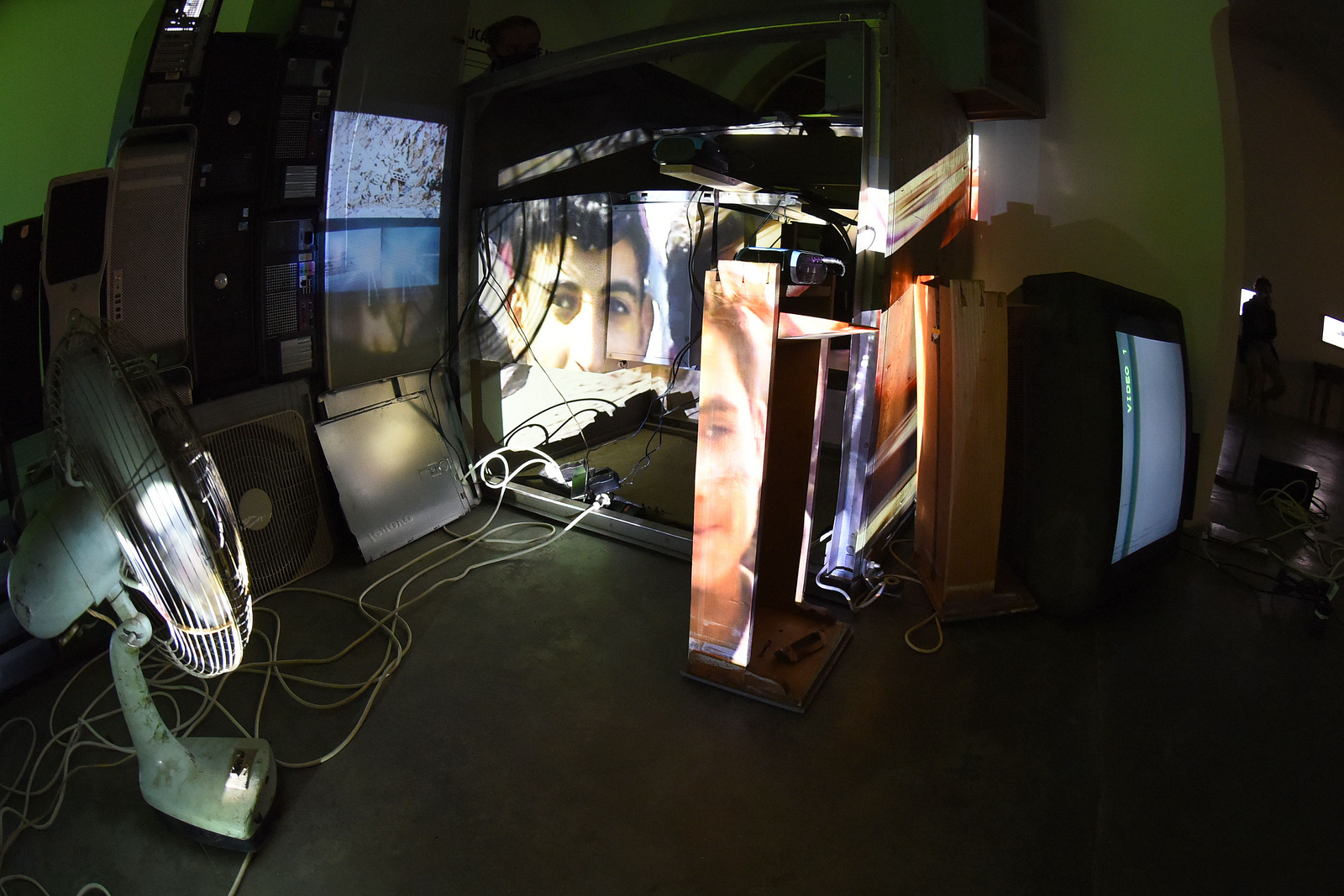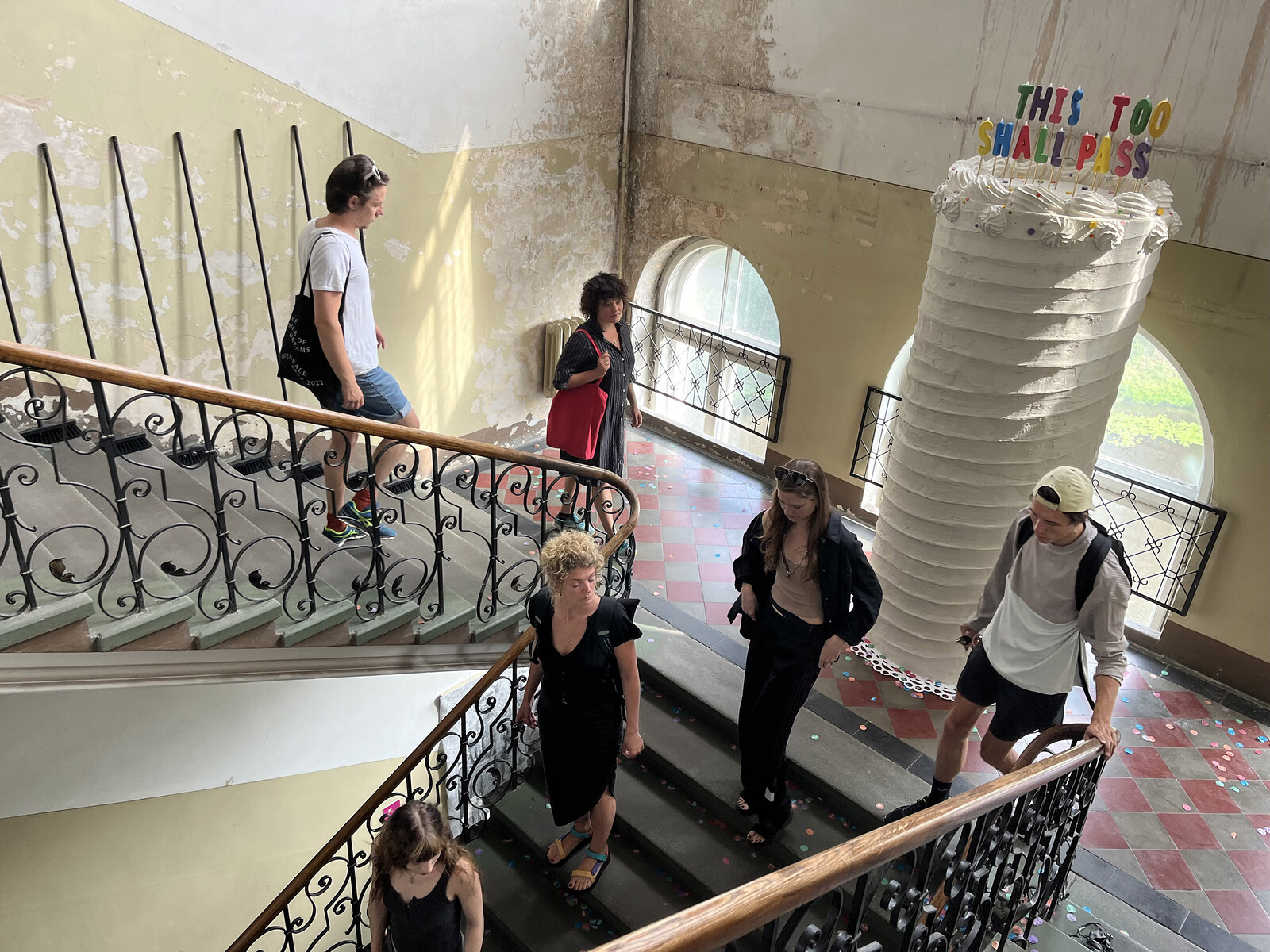
Detail of Nedko Solakov, New Noah’s Ark, 1991–2007. Photo by Svetlana Kuyumdzhieva

“A Sort of Retrospective”

Svetlana Kuyumdzhieva

Print | Email Share this paper on:  Facebook | Delicious | Digg | Twitter |

“A Sort of Retrospective”[1]

“Nedko Solakov” Curated by Iara Boubnova and Maria Vassileva at Sofia City Art Gallery, 7 May to 5 June 2009

By Svetlana Kuyumdzhieva

Translated by Vassil Yovchev
Edited by Zhivka Valyavicharska

It is with difficulty that I recollect the first time I saw a Nedko Solakov original. I think it was in 1999, at the “Locally Interested” exhibition, curated by Nedko Solakov and Iara Boubnova; it caused quite a stir back then, one that still holds us in its sway. But it may have been earlier, at ATA, or in 1996, at that doodles thing on the mirrors of the National Art Gallery, a work which left a deep impression on me. Later I had a much more conscious relationship with his work, in 2002, while preparing, jointly with Vessela Nozharova and Svetlin Roussev, the retrospective of Bulgarian art of the 1980s, a project that we pieced together from works of art that had for years laid forgotten in the storage rooms of municipal and state-owned galleries across Bulgaria. By that time Nedko Solakov’s biography had already grown to the monstrous size which now not just generates respect but intimidates. But the odd thing remains that he used to be popular only among a handful of professionals and his name was always mentioned in a whisper—(things have been changing in recent years, albeit unhurriedly). It is indeed hard to grasp the paradox that the work of the world’s most famous Bulgarian contemporary artist can be seen in his native country only in the dusty museum collections acquired at various group shows.[2] For example, the generation I belong to is still working to the utmost to set its unburdened mind to solving this puzzle. For his part, Nedko Solakov seems to have waited for the lifting of a long quarantine to begin retelling, in a solo exhibition, his past, and to let us into his present.

The “total” installation

What could clearly be seen at this exhibition was that the artist had done his best to clear away at least part of the paradoxes. Simultaneously, he appeared to be seeking the latest in a series of atonements for his already mythicised guilt, as well as recognition for his success. Solakov had tried to anticipate the audience’s impulses and to answer any likely, unasked questions—he had gone as far as to prepare his own responses to potential criticism or attacks, fully in line with his style: even a fatal dénouement must be anticipated, pre-empted or subdued. At the exhibition, everything moved in a sequence of his own engineering and was being controlled down to the minutest detail. This trait of Solakov’s is no less known around the world than is his art. The retrospective was a true disappointment for anyone who had been warming up to experiencing the flashiest exhibition in their lives. What they saw was a stupefying chaos made up of piles of pictures and various indiscriminately arrayed objects. Alongside his early paintings (again dug out from those same storage rooms), Solakov used parts of his own archive of the past 30 years—details of works, documentary material, photographs, publications, intimate moments, phobias and curious biographical episodes. It looked as if he had emptied out his own storage room and dumped the various bits into the gallery. The entire contents—glasscases and pedestals in their authentic, most decrepit state—were also turned into art, or rather into a system of navigation to help one find his way through the years. Quite in keeping with the style of “total” installation, the spectators found themselves in an unnatural situation in which they were pushed to either use the maximum of their cultural potential or give the whole thing up while they were still at the entrance door. The physical effort one needed to squat, lean forward, jump over or tiptoe to be able to see or read something was itself part of the work. Because, ultimately, this entire exhibition proved to be a single work of art. The “total” format enabled both the artist and his curators, Iara Boubnova and Maria Vassileva, to present the selection in a most adaptive way. A considerable portion of the works was present only in the form of fragments or documents, accompanied by short notices that the works are already in the possession of someone else.

But despite the meticulousness employed in the creation of this visual guide on how to read and understand Nedko Solakov, this retrospective still carried the risk of leaving the artist forever unfathomable and unaccepted—maybe because it introduces a standard that remains both unfamiliar and too difficult to decode.

Biography – between Black & White

The installation was set up as framed within the A Life (Black & White) (1998), one of a handful of Solakov’s laconic but philosophically charged projects, and perhaps his most reproduced work. This time the black and the white were chasing each other along the gallery’s outer walls. Everything remaining was inside, on the columns, parapets, cross-beams and the inner wall. The chronology which the exhibition traced began in the late 1970s with an introduction in which Nedko Solakov had a dream that he was flying… Then came the 1980s, a period in which, in the area between the “associative metaphorism”[3] and the need of using Aesopian language, Solakov acquired a greater awareness of the conceptual power of painting. The gallery’s first hall hosted a considerable number of Solakov’s early pictures, which, in their local context, are still admired even by his most vehement critics. The key value of these pictures is their criticism, severe and clever. In the past the fate of these pictures used to be decided at group exhibitions, by art commissions and juries—Solakov’s additional commentary served as a guide to the institutionalised and regulated nature of the decade to which they belong. At the end of the 1980s and later, Solakov progressively turned away from this overly undemanding way of communicating with the Bulgarian audience.

Nedko Solakov is a descendant of the conservative traditionalism with mechanisms of stable continuty to which all Bulgarian artists belong. In this exhibition he was unreservedly sincere in his confession about the uncertainties he had had concerning his own artistic choices. Sometimes prodded by circumstance and life’s vicissitudes, sometimes by an idea of his own, he gradually transformed his set of expressive tools and sought ways ahead in the world of stereotyped norms and templates. Among the critical steps in this metamorphosis was the “The City?”, a 1988 exhibition curated by Filip Zidarov. Zidarov’s idea to have the artist group “The City” participate in an exhibition in which there was anything but painting is still regarded as a breakthrough in the history of Bulgarian contemporary art. “The City?” highlighted a major turn in Solakov’s current retrospective. The following year he looked to the west, both figuratively and literally (the telescope from his View to the West, with which he took part in the “Earth and Sky” exhibition (1989), managed by Diana Popova and Georgi Todorov, was now prominently featured), and has never looked back since. It was at this key moment when Top Secret (1989–90) came up. Although difficult to identify among the heaps and the supposed disarray, it was simultaneously the divide in Solakov’s art and the beginning of the period in his work that has remained unknown for many in Bulgaria.

In 1991 Nedko Solakov did New Noah’s Ark, his first “big narrative installation”. However, apart from his having settled on a format of his own, Solakov sought much more universal channels of communication—a pursuit which unleashed a different thematic potentiality in his art. It appears that then he turned away from the reality he had known and entered a different, less attainable territory. This was a long period, in which, as time went by, Solakov enriched his narrative with further details, new capacities of expression and fresh particulars. Nonetheless, the canvas, as it were, can still be seen and felt despite the transformed thematic repertoire. Consciously or not, along with the autobiographical elements, in his work Solakov always preserves his own share of traditionalism. In one way or another, this foundation participates in the final impact of his installations and remains an integral part of his approach. And it was this characteristic that made the fragments at the exhibition even more revealing. The chronology traced Nine Objects, which was presented at the National Museum of History in 1992–93; Wallpaper (1993); Market (The Artist as  Curator) (1992–93); Seven Little Pleasures for Seven Boring Days (1991–93); The Superstitious Man (1992–94); The Collector of Art (1992); The Truth (The Earth Is Planeq the World is Flat) (1992–95); Mr. Curator, please…(1995); Wallpaper (1995); the fascinating self-portrait as a snowflake in This is me, too…(1996); documents from Doodles (1996); The Absent-Minded Man (1997)—presenting the enormous yellow vinyl spot spread across the gallery’s two halls; the cynical cakes kneaded with clipped nails in Help Yourself  (Russian Roulette) (1998); On the Wing (1999–2000); El Bulgaro (2000); documentation of Romantic Landscapes with Missing Parts (2002). There were almost 100 works that took the viewer to his Announcement (1999), which represented Bulgaria at the Venice Biennial in the same year; Opportunity and Realized Opportunity (2005), which appeared at the Sharjah and Istanbul biennials; Some Personal Taboos from the 2005 Tirana Biennial; fragments from Discussion (Property), awarded honourable mention at the 52nd Venice Biennial; the album which Phaidon Press, London, published in 2008 featuring the Fears series of drawings (2006–7)—they were at Documenta 12; documentation from the “Emotions” exhibition, which was shown at three European museums; documentation from A Recent Story with Ghosts, a Pair of High-Heeled Shoes, (a couple of floods) and Some Other Mischievous Acts, which was displayed for the first time at the 2008 edition of the New Orleans Biennial.

Nedko Solakov never returned to the critical impulse of his early works. No matter how rich in detail and committed to the concrete, in its own peculiar way his narrative succeeds in turning reality’s most dramatic absurdities into fantasies and almost invented subject matter. This should not be construed as if the artist has severed his connections with this reality. On the contrary, in each subsequent exhibition he appears in a greater and deeper dependence on it. But it is grounded in another, I’d say mediated, semantic field: real events get mixed in a complex amalgam in which criticism appears as irony, the irony of the outside observer. Further, any context in which Solakov’s works appear can completely transform the artist’s original idea and the already created narrative. Such is the case not only with the air pockets, holes and cracks from which, traditionally, Solakov crafts entire stories, but also with the cultural peculiarities of the places he finds himself in. To be sure, it is rare for him to kick the wall in anger (as he did at the Sofia City Art Gallery), but his involvements are permanent, stuck into the architecture, context and heritage which this artist carries everywhere. Without a doubt, Nedko Solakov is the roving teller of tales who after each journey adds to his stories a new layer of experience.

Text

Text, of course, was the focal point in this huge installation of Nedko Solakov’s, , and the latter would have been meaningless without the artist's  notes and commentaries; they crawled, as it were, all over the gallery’s interior. The words’ role was at least triple: they took the spectator through the artist’s biography, through the history of contemporary art in Bulgaria and through the annals produced by the local art stage—as it appears to us at the moment. On another level, text was the key ingredient in the works themselves: it appeared in the reproductions, in the catalogues, in the videos. There was also text in the people’s hands as they were ambling entranced around the gallery. That is why it may be fair to say that this exhibition was to be experienced by reading rather than by watching; (and it was a patient reading, at that). The translated text itself—into Bulgarian from English—came across as a significant artistic act, just as were the messed-up spelling or the technical difficulties in the way the words were written out. Everything was scrupulously retold by Nedko Solakov, which means that it was, again, reduced to sheer text. Text was the strongest aggressor here, and the instrument that was most vigorously plied.

Bulgaria’s reality as a quotation

It was not due to oversight that the gallery’s entrance was flanked by a pair of enormous quotation marks. Nedko Solakov told the news conference that preceded the opening of the exhibition that, in reality, the quoted text began inside out: at the place where our real life begins. We have no reason to discount this statement: It is precisely in quoting the bits of reality which he faces every time he’s back in Bulgaria where the essence of Solakov’s art lies; he centres his work on fragments that in themselves are so absurd and eloquent that it is enough to move them into a museum and they will be transformed into the most eccentric conceptions. However, Solakov reaches further than that: he uses quotation as the base upon which he adds further building blocks—the simplest narrative, pieces of history, meetings with people who inhabit this reality—all of them immersed in the pool of media and means of expression that this reality procures.

Nedko Solakov studies and uses these “quotations” most rationally, not just as an exportable good, but as an opportunity to reverse the point of view, to offer a new reading perspective and to come up with his own attitude towards the native environment.

"End of Quotation"[4]

This was the first solo exhibition of Nedko Solakov at which I’ve attended. For me and for the people who are familiar with the current way his art is developing, it held no surprises. Its underlying philosophy completely overlapped with Solakov’s work produced for the most prestigious museums in the world. I venture to think that any free associations with the neglected muddle of the 1980s would  help its interpretation in Bulgaria.

I am fully aware that by daringly referring to Nedko Solakov as “the world’s most famous Bulgarian contemporary artist” I run the risk of incurring upon myself, for an umpteenth time, certain people’s anger. And, curiously, this, too, seems to me one of the paradoxes that I mentioned earlier. The exhibition incorporated those parts of the artist’s effort—the unrealised projects, the early-years’ misguided wanderings, even the mistakes—which have brought on this definition in its purest. His leading position is now indisputable, but maybe this is something that will prove unnecessary: in his own words in the video to Top Secret, Solakov has always been an exellent student—in school, at the academy and in his work for the Communist Youth Union… I think it would be a much more fruitful effort if this success is processed without the brakes of the common past, personal relationships and any presumed accusations. It is only in this way that the foundation will be laid not only for a thought-out and constructive critique of Solakov’s art, but also for the appearance of a more dignified understanding of Bulgaria’s art community.

The text was originally published in the Kultura Weekly (Issue 19, March 19, 2009)

Svetlana Kuyumdzhieva (born 1977) is a critic and curator based in Sofia, Bulgaria. She graduated in 2003 and holds an MA in Art History from the National Academy of Arts, Sofia. For six years now she has been working as a curator at the CIBANK Gallery, one of Sofia’s most reputable non-commercial art spaces. She is a committed art critic with her own column in Kultura Weekly, a specialised newspaper, and is also a freelance consultant on contemporary art for several Bulgarian weekly and monthly publications.

Ms. Kuyumdzhieva is a guest curator at numerous venues that focus on contemporary art in Bulgaria, and carries out her own projects.

The text was originally published in the Kultura Weekly (Issue 19, March 19, 2009)

  1. The use of quotation marks is intentional. It is how Nedko Solakov has elected to entitle his first solo exhibition in Bulgaria after a hiatus of more than 20 years.

  2. In the Socialist era, special art commissions at group exhibitions made decisions about which works of art should be purchased by the state to stock municipal or state-owned art collections across the country.
  3. A Bulgarian art term from the 1980s. It described the common tendency in Socialist Realism of an ever-increasing interest in metaphorical iconography and subject matter.
  4. I admit that to end this text and in an effort to go back to that key moment I succumbed to the temptation to use the name of the 1990 exhibition, curated by Luchezar Boyadjiev. It was the event at which Nedko Solakov presented his Top Secret for the first time. His confession that during his undergraduate years he had had contacts with the Communist state secret services resulted in a years-long rupture with Bulgaria’s art world. This rift still bears on the way this artist is regarded in Bulgaria
CalArts
Staatliche Hochschule für Bildende Künste
San Francisco Art Institute
USC
Columbia