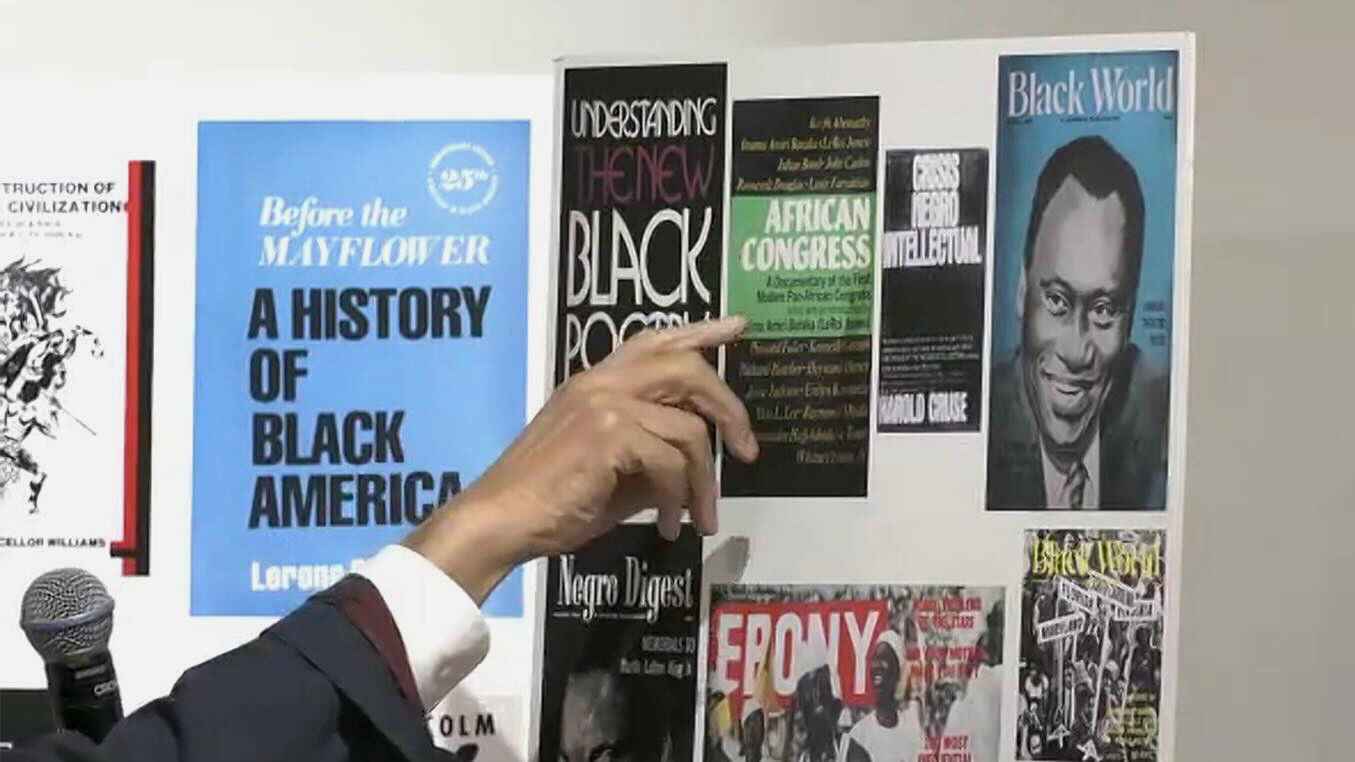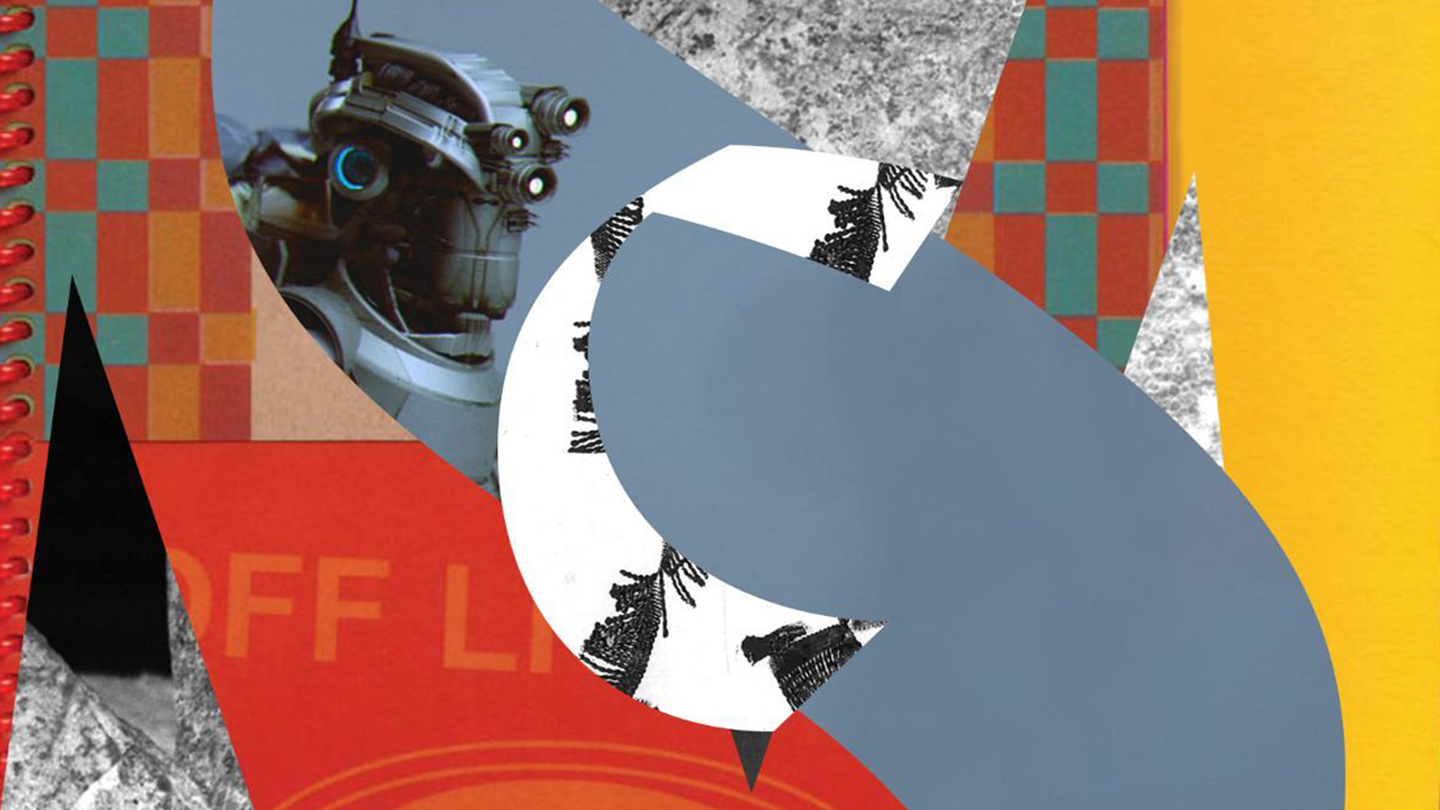
Vanity Fair Artworld Collage, Cantos Cívicos, 2008


Art Under the New World Order

Irmgard Emmelhainz

Print | Email Share this: Facebook | Twitter |

Art Under the New World Order

It would seem that art must now either abolish itself entirely – the audacious strategy of the avant-garde – or hover indecisively between life and death, subsuming its own impossibility into itself.[1]

If we understand deregulation as the absolute rule of the market, what are the conditions of aesthetic production under deregulation? How have art and its production been influenced by the predominance of neoliberalism and by the shift toward cognitive production as a source of surplus value? Is contemporary art, now subsumed to the rule of the market interests, caught in the Adornian impasse between life and death?

As we all know, a massive process of capitalist accumulation is taking place by way of financial capitalism, dispossession of vital resources and land, annihilation of forms of life, mass privatization of the commons, the redistribution of power in favor of the elites, and the repression of dissent from Toronto to Deraa, Syria, passing through Rome, Beil’in and Athens.[2] We are seeing the ruins of the worker’s movement from the 19th Century bourgeois industrial order; witnessing the 20th century welfare state collapse at the feet of neoliberal measures like outsourcing, deregulation, de-unionizing, exploitation of factory labor, downsizing, the precarization of labor, cut-throat competition at the work place (social Darwinism), the inextricability of the legal economy and the rogue or illegal economy, speculation with food prices, etc. Moreover, the shift that began to take place in the 1970s from the industrial production of merchandise to an economy based on knowledge and information has prompted an international division of labor. That is to say, transnational capital has created new forms of mobilizing and exploiting the working force at a global scale, uprooting and displacing hundreds of millions of peasants from the third world, transforming them into national and transnational migrants working under enslaving conditions.[3] Production in the first world has come to be based on semiotic content centering on cognitive production like marketing and branding, placing creativity at the core of the actual economic system–what Franco Berardi (Bifo) has called SemioKapitalism.[4] In this scenario, art has joined the economy of knowledge and become subject to what Theodor Adorno called the culture industry. “Culture industry” denotes a tendency toward uniformity within apparently varied and free production that mirrors the dominant logic of the global social process of the production of the same.[5]

As part of the economy of knowledge, art carries the burden of becoming a form of knowledge all the while it derives its value from a context, second hand removed. Furthermore, academia, by way of critical theory and art history, insures the further validation of art as a form of knowledge within the market. The reason for this is twofold: in the current economic order, on the one hand, the sector of the arts and culture is seen as a potential financial boom where it has become necessary to invest. As Rosalind Krauss noted in 1990, art had become an asset, and what gives art its value is not that it is thought of as cultural patrimony but that it is considered to be specific and irreplaceable embodiments of cultural knowledge whose value is one of pure exchange.[6] On the other hand, following Jean Baudrillard, art has fulfilled its avant-garde potential, having morphed everywhere to become embedded into everyday life. Art can now use everything for its own purposes, “from recycling garbage, to forming communities, to investigating political issues and perfumes, to playing with television, anthropology, biology and technology.”[7] The trouble in distinguishing art from other kinds of processes is not only related to art having reached its vanguardist ideal, but also ties in to Adorno’s thesis of the Culture Industry as the production of sameness. In any case, in order to be able to distinguish itself from other fields, contemporary art needs validation as some form of knowledge. In this regard, Sylvere Lotringer located a paradigm change in art production grounded on the reception of Jean Baudrillard’s Simulations in the New York Artworld as a tool to imbue art with theoretical weight. Lotringer wrote:

The year 1987 happened to be a real turning point for the New York Artworld, throngs of young artists were flooding the art market desperately seeking Cesar, a “master thinker”, a guru, anything really to peg their career on; they took Jean Baudrillard’s book, Simulations for an aesthetic statement (while it was an anthropological diagnostic) and rushed to make it a template for their art.”[8]

In this regard, academia has served the purpose of affirming the separation of art from socio-economic relationships, as it needs to prove its status as a space for critical thinking outside from the capitalist system; at the same time, the Artworld has sought (or not) to distinguish itself from transnational corporate ventures that claim the creativity that used to belong to the domain of art. For example, Chris Kraus argued recently that the company American Apparel fills “the void left by avant-garde process-art of the last century, which are no longer practical for artists who must maintain their career.”[9] For Kraus, American Apparel is a “gigantic work of conceptual art,” with its stores that look like galleries in to-be-gentrified neighborhoods, with its Warhol-esque operational mode, with its anti-brand attitude and its ads that look like MFA art and which quote conceptual artworks.[10]

One of the consequences of the expansion of art into economical processes and its migration to discourses of creativity has been the emergence of the “creative class”:[11] an economic class not because its members have certain professions, but because they “adopt a common lifestyle: an outlook on life that cuts across and ties together the different registers of work, leisure, self-actualization and social goods.”[12] Another consequence is, as Eric Cazdyn and Imre Szeman noted recently, art has ceased to matter as art, and thus its politics are gone:[13] evidently the global Artworld, the market and political engagement are not at odds with each other but rather, they coexist for mutual benefit. In this schema, much politicized artwork sits within the confines established by liberal ideology that on the one hand, reduces the political to culture by institutionalizing dissent and staging antagonism. On the other hand, the model of aesthetic practice that predominates mirrors corporate ideology. For example: the cultural producer is a nomadic entrepreneur against a centralized art world; political commitment–long gone are the politics of visibility of the 1980s and 90s–means dialogue, cooperation and the creation of communities; betterment is sought as opposed to change; culture and knowledge serve as tools against poverty; spontaneous relational interaction and autopoiesis are means to undo fixed representational strategies.[14] The Modern vanguardist role of the artist as mediator is gone as the exploited class appears as a “social issue” and as subject of direct intervention and of denunciation, for example: the oppression of Muslim women, religious fundamentalist violence, the exploitation of immigrants, humanitarian crises, conditions of life in the slums, etc. As politicized work, aesthetic interventions and politicized gestures are shadow-theater battles that fail to address the new realities of capitalism. Furthermore, contemporary art thrives on what Mark Fisher calls the aesthetics of demise, taking up the ethico-political task of showing the horrors of capitalism in the most realistic manner, turning spectators into stupefied, passive contemplators.[15] The aesthetics of demise encompasses works that abstract current forms of violence exercised on the social and urban tissues and reifies them into images, objects or gestures. It is characterized by being direct, real and immediate. By eliminating mediation, it renders transparent the mechanisms of transmission, similar to mediatic “objectivity.” It is not by chance that aesthetic practices coincide with the mass media, as both regimes fall short in their attempts to transmit pain, fear, the ruin of cities, the sequels on the collective psyche left behind by murders, torture, rape, war. Not coincidentally, much of contemporary art shares with journalism the method of empirical investigation as its basis of production: like journalists, artists are “citizens of the world” and witnesses to the consequences of globalization on the planet. Moreover, aesthetic practices seek to compensate for the blind spots of the information industry, and have taken up the task of highlighting what is suppressed in current global political and cultural processes, intending to put at work the criticality that the media lack.[16] Such a view of the “world picture”[17] believes that the picture presented by journalism can be transcended by aesthetics, insofar as it allows for formal experimentations and is able to go beyond “technology” – positing the cognitive mapping of the world as a matter of technique. The problem is that art, like the media, draws up a horizon of legibility in common, outlining a frame of what can be done and said, what positions may be legitimately taken and in which actions one can become engaged in or not: journalistic and cultural tourism; cultural intervention, in debates carried out by ‘experts.’ This horizon of legibility is a matter of power relations and it has to do with the articulation of political frontiers in a discourse and thus, social divisions become a matter of limits creating an ‘inside’ and an ‘outside.’ This is how social divisions are established between concerned citizens of the world and victims, cultural producers and informers and sufferers, cultural products and subjects of the work, victims and spectators. Such a division was cynically (self-reflexively?) drawn by Santiago Sierra in his intervention for the 2001 Venice Biennale: 133 People Paid to Have their Hair Dyed Blonde. Sierra’s action highlighted (literally) a division between the poor illegal immigrants in Venice (mostly Subsaharian) and the Artworld crowd mingling on the streets of Venice that summer.

When facing the contradictions of politicized aesthetic practice within the current World Order, it is often argued that capitalism recuperates the criticality of art. The recuperation of criticality by capital is a myth, however, when we consider Eve Chiapello and Luc Boltanski’s distinction between “social critique” and “artistic critique” alongside the “creative” turn in capitalism since the 1970s. The two forms of critique that Chiapello and Boltanski conceptualize, posit demands for liberation. On the one hand, social critique denounces poverty and exploitation and demands liberation from oppression suffered by a people lacking political self-determination due to historical conditions. On the other hand, artistic critique demands authenticity and self-fulfillment. In terms of self-fulfillment, artistic critique is against generic alienations prompted by religion, authority, community, having a given body, etc. With regards to authenticity, artistic critique is against standardization and massification by capitalism. According to Chiapello and Boltanski, while artistic critique has been partially fulfilled and subordinated to profit making since the 1970s, social critique and anti-imperialism were attenuated by being transformed into ethics and human rights, reduced to denunciation, disagreement, making visible what the mass media do not show, confusing social work with engaged art, etc., dispossessed of their ideological base and consigned to the trash-can of history.[18] Artistic critique, in turn, has been put at the center of life becoming ideology and a source of capitalist profit. The subsumption of artistic critique to profit-making means that the politicized demands of autonomy from fixed hierarchies and determinations that stem from gender, society, ethnicity, etc. have migrated to the market of counter culture become mainstream. This has given leeway to the trend to create autonomously one’s own subjectivity and lifestyle by way of commodity ownership, that is, a matter of the consumption of semiotic products. Lifestyle has become a value and the site for the creative invention of a “free self” as well as the grounds for the pursuit of hedonistic practices in the name of personal freedom; also, self-fulfillment has come to mean to give one’s own life a purpose and social responsibility. Moreover, artistic critique has been placed at the center of human life activity, and become part of the current ideological trend to live for the sake of self-fulfillment and to make life meaningful. As Slavoj Zizek stated:

We have this ideology that addresses you as a private individual and accepts you; and you are not destined to care for higher causes but to dedicate your life to self-fulfillment. In this situation, our ideological identity is that of individuals whose task is to realize their true potential and to make their life meaningful.[19]

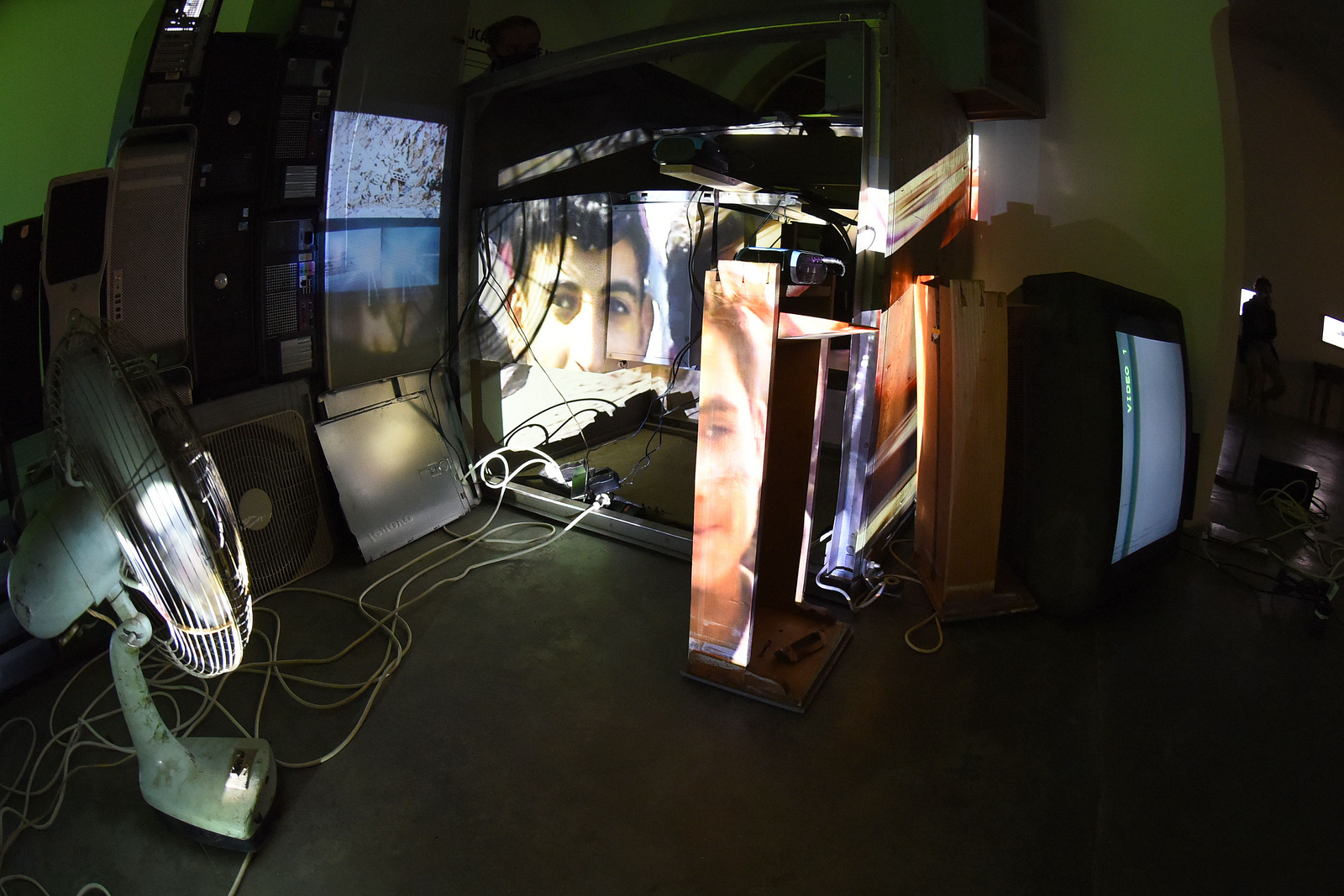
Thus, the current ideology of self-fulfillment implies de-alienation and autonomy, which get satisfied by semiotic consumption. Even social responsibility is a matter of semiotic consumption, and lifestyle provides a framework to our lives and sense to it, becoming the site for the creative invention of a socially aware “free self.” To conclude, if lifestyle is in old-fashioned terms the predominant form of “ideology,” then contemporary art could be charged as guilty of its inability to create an alternate or critical model that would oppose it. The writer, critic and filmmaker Chris Krauss, in her dialogue with Baudrillard’s and Lotringer’s assessment that art has completely merged with life, wrote that “the art world remains last frontier for the desire to live differently.” In her view, artists are searching for a new kind of living, documenting their approaches and placing them in relation to each other, reclaiming public space and time. Artistic critique integrated into a capitalist vision, as we have seen, emphasizes creativity and self-fulfillment, and as lifestyle, it is the predominant form of ideology. One of the devastating consequences of this is the effect it has had on our perceptive critical capacity to truly understand the underlying forces behind our current personal drives and desires in the context of the ongoing wars and the geopolitical-economic landscape. According to Gene Ray, the issue at stake in the Culture Industry’s production and consumption of commodified culture is the production conformist consciousness, “the restriction, impoverishment, and seduction of consciousness.”[20] The Culture Industry, however, never absorbs entirely the autonomy of art, which can be actualized as a force of resistance. For example, Miguel Ventura’s 2008 humongous installation, Cantos Cívicos at the Museo de Arte Contemporáneo (MUAC) at the Autonomous National University in Mexico (UNAM). The motif of a swastika linked to the dollar sign appeared throughout an overwhelming collage made up of intervened images of Iraqi soldiers, male pornography, Nazi paraphernalia, a parody of the Artworld, hints of the colonial atavisms remaining in contemporary Mexico, etc.

The work was unpalatable for many, especially for the institution that hosted it.[21] This installation and the debates that it spawned, demonstrates that the critical potential that art has, goes well beyond artistic critique in Boltansky and Chiapello’s sense, as there exists the possibility of expressing and then presenting the unclassifiable, unsellable, unshowable, the abject: a disturbing image of the world that may distantiate us from the present. This takes place beyond the well-known, ready-made liberal margins that have been set up by the culture industry precisely for politicized artwork and art writing.


Irmgard Emmelhainz obtained a Ph.D. from the University of Toronto with a thesis on Jean-Luc Godard and the Palestine Question (2009). She is currently an independent writer, translator and researcher based in Guatemala City where she also teaches cinematic analysis. She has published extensively on contemporary art and cinema in magazines and journals across the world and has a book of essays forthcoming in Spanish on aesthetics and geopolitics.

    1. Theodor W. Adorno, Letter to Walter Benjamin, London, March 18, 1936, Aesthetics and Politics, (London: New Left Books: 1977).
    2. For example, the millionaire budget to securitize downtown Toronto as a preventive measure of the anti G8 demonstrations in 2010; the use of live ammunition, and shooting rubber bullets and gas canisters by the Israeli army against pro-Palestinian protestors; violent repression and torture in Baharain, Syria, Honduras; the complicity of European countries, especially Greek authorities in stopping the “Freedom Flotilla II” and the “Flytilla” to Gaza in July 2011; the prosecution of activists in Mexico (Atenco and Oaxaca since 2006), etc.
    3. William I. Robinson, “Global Capitalism and 21st Century Fascism,” Al Jazeera English, May 8, 2011. Available online: http://english.aljazeera.net/indepth/opinion/2011/04/201142612714539672.html.
    4. See: Franco Berardi (Bifo), The Soul at Work (Nueva York: Semiotext(e) 2009).
    5. Gene Ray, “Culture Industry and the Administration of Terror,” Gerald Raunig, Gene Ray and Ulf Wuggenig, eds. Critique of Creativity: Precarity, Subjectivity and Resistance in the ‘Creative Industries’ (London: Mayfly, 2011), 169.
    6. Rosalind Krauss, “The Cultural Logic of the Late Capitalist Museum,” October 54 (Fall 1990)
    7. Sylvere Lotringere, “The Piracy of Art,” The Conspiracy of Art (New York: Semiotext(e), 2009), 13. This essay was originally a response to an essay by Eshrat Erfanian titled: “The Art System; Theory as Medium and the Crisis of the Image,” and it is available here: http://muac-nilc.blogspot.com/2010/08/art-system-theory-as-medium-and-crisis.html.
    8. Sylvere Lotringere, “The Piracy of Art,” The Conspiracy of Art (New York: Semiotext(e), 2009), 14.
    9. Chris Kraus, “Where Art Belongs,” (New York: Semiotext(e), 2011), 136.
    10. Chris Kraus, “Where Art Belongs,” (New York: Semiotext(e), 2011), 138.
    11. Richard Florida’s term.
    12. Eric Cazdyn and Imre Szeman, After Globalization (New York: Wiley-Blackwell, 2011), 82.
    13. Ibid.
    14. See: Slavoj Zizek, “Against Liberal Communists,” London Review of Books Vol. 28, no. 27 (April 2006).
    15. See: Mark Fisher, Capitalist Realism (London: Zero Books, 2010)
    16. Stefan Jonsson, “Facts of Aesthetics and Fictions of Journalism: The Logic of the Media in the Age of Globalization” trans. Charly Hultén, Nordicom Review 1-2, (2004), Special issue of the 16th Nordic Conference on Media and Communication Research, Edited by Ulla Carlsson. URL: http://www.nordicom.gu.se/common/publ_pdf/157_057-068.pdf. Date Consulted: September 2 2009
    17. Martin Heidegger, “The World Picture,” The Question Concerning Technology and Other Essays, New York, Harper and Row, 1977, pp 115-136
    18. Luc Boltanski & Eve Chiapello, The New Spirit of Capitalism (London: Verso, 2001), p. 346.
    19. Zizek in an interview about his book, On Violence in the radio program “Against the Grain” on September 9th, 2008. Available on line: http://www.againstthegrain.org/program/92/id/370220/tues-9-09-08-i-ek-violence
    20. Gene Ray, “Culture Industry and the Administration of Terror,” Gerald Raunig, Gene Ray and Ulf Wuggenig, eds. Critique of Creativity: Precarity, Subjectivity and Resistance in the ‘Creative Industries’ (London: Mayfly, 2011), 170-171.
    21. For a compilation of the debates triggered by the exhibition and articles written about it go to: cantoscivicos.blogspot.com/
School of Visual Arts
Royal Institute of Art Stockholm
HFBK
NSCAD
Emily Carr
Lesley University